
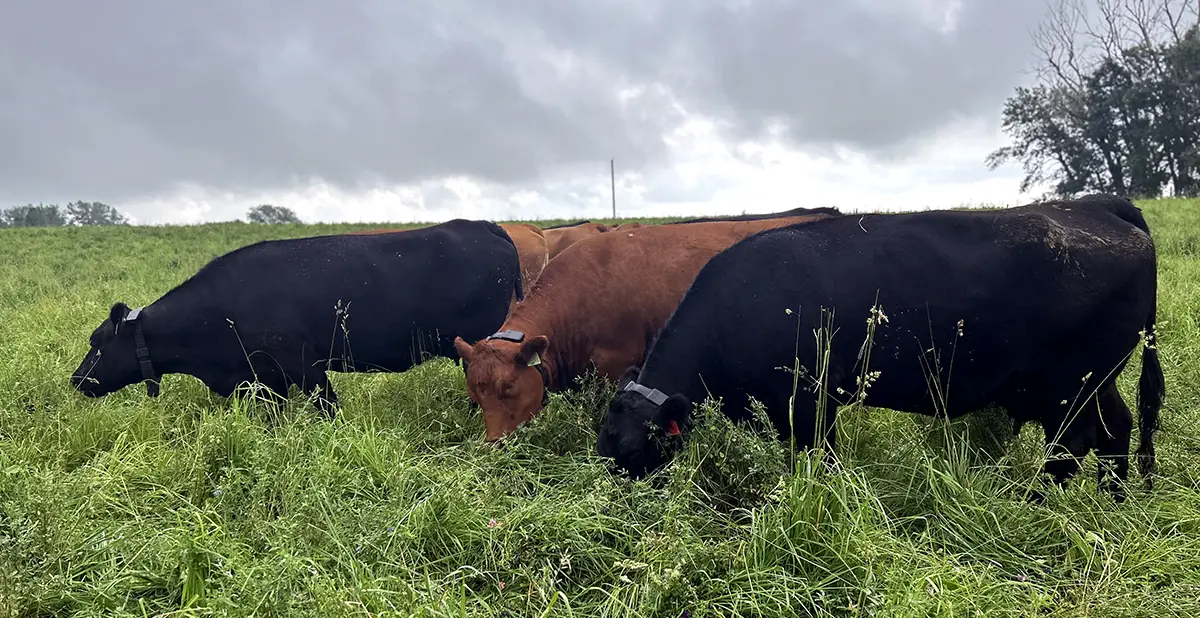
The Technology Access Centre for Livestock Production (TACLP) at Olds College of Agriculture & Technology is the first Canadian research centre to receive and evaluate cutting-edge virtual fencing collars from the New Zealand-based company, Halter. This project was made possible by funding from RDAR (Results Driven Agriculture Research).
Virtual fencing technology is an emerging tool in the livestock industry, offering producers the ability to manage cattle movement with precision and flexibility without relying on physical fence infrastructure. Enabled by advances in GPS positioning, animal behaviour science, cellular connectivity and mobile application platforms, virtual fencing systems allow digital grazing boundaries to be established and modified remotely. These boundaries are communicated to animals through audio cues followed by mild electrical stimuli, training cattle to respond to non-physical signals and enabling controlled movement within grazing areas.
Applied research trials, including at the TACLP, have evaluated earlier generations of virtual fencing technology, providing valuable insight into training protocols, animal response and operational feasibility. However, rapid technology development has resulted in significant system and hardware updates that have not yet been evaluated under western Canadian conditions.
Halter has recently entered the Canadian market with their updated system architecture, intended to improve usability, connectivity and operational performance. The new design has not yet been tested in Western Canada, where terrain variability, large pasture sizes, climatic extremes and inconsistent cellular coverage may influence system reliability and adoption outcomes.
To assess Halter’s new virtual fencing collar design, collars have been deployed on 80 cow/calf pairs grazed on Olds College land, as well as 35 cow/calf pairs and 35 yearlings within an active grazing system at a partner producer’s operation, to assess technology performance, usability, connectivity and animal behaviour under commercial conditions. Building on existing research, this project will generate producer-relevant data to support informed adoption and continued development of virtual fencing systems in Western Canada.
To learn more about research projects at the TACLP, visit oldscollege.ca/TACLP.
The Smart Farm is working towards providing producers with real-life applied research to help them make informed decisions about implementing technology in their own operations.