
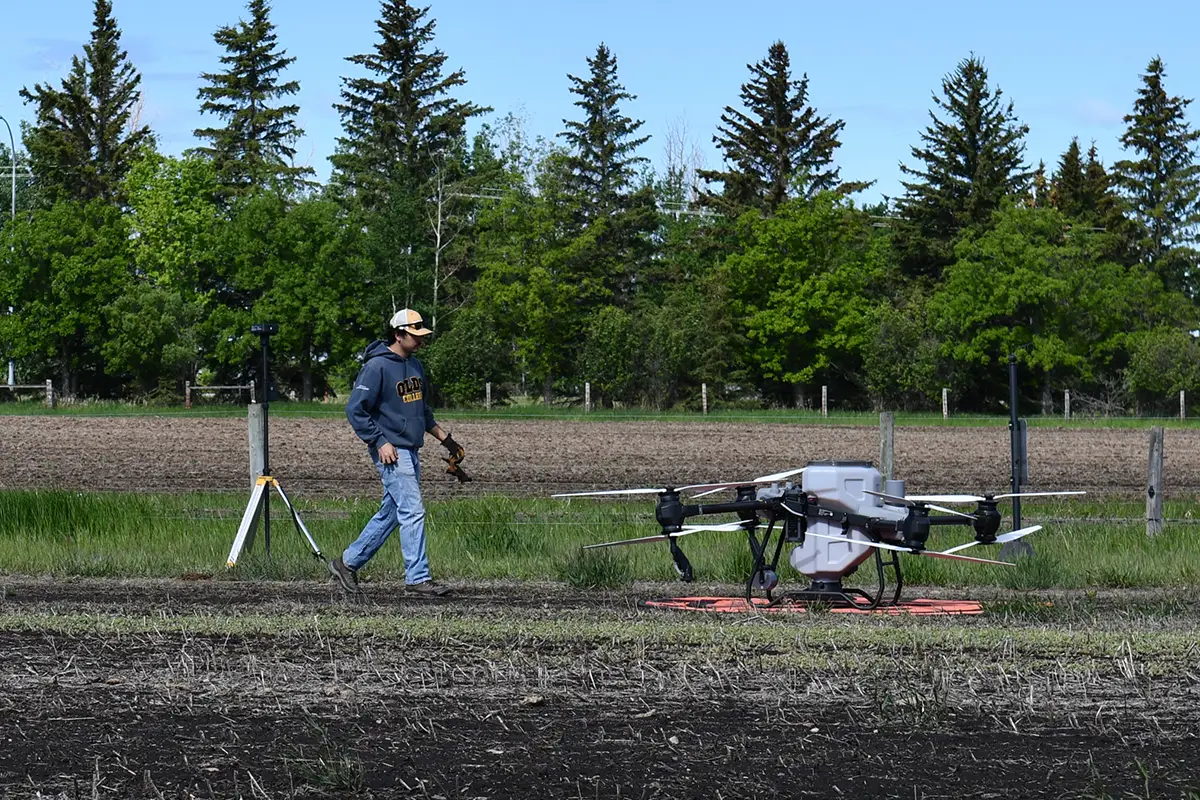
With funding from a Canadian Foundation for Innovation grant, Olds College of Agriculture & Technology’s Smart Agriculture Applied Research team purchased a field sprayer drone for the 2026 growing season. While the drone is commonly used for pesticide spraying and other crop protection applications, it has the capability to spread a variety of granular materials, creating additional opportunities for use on the Smart Farm.
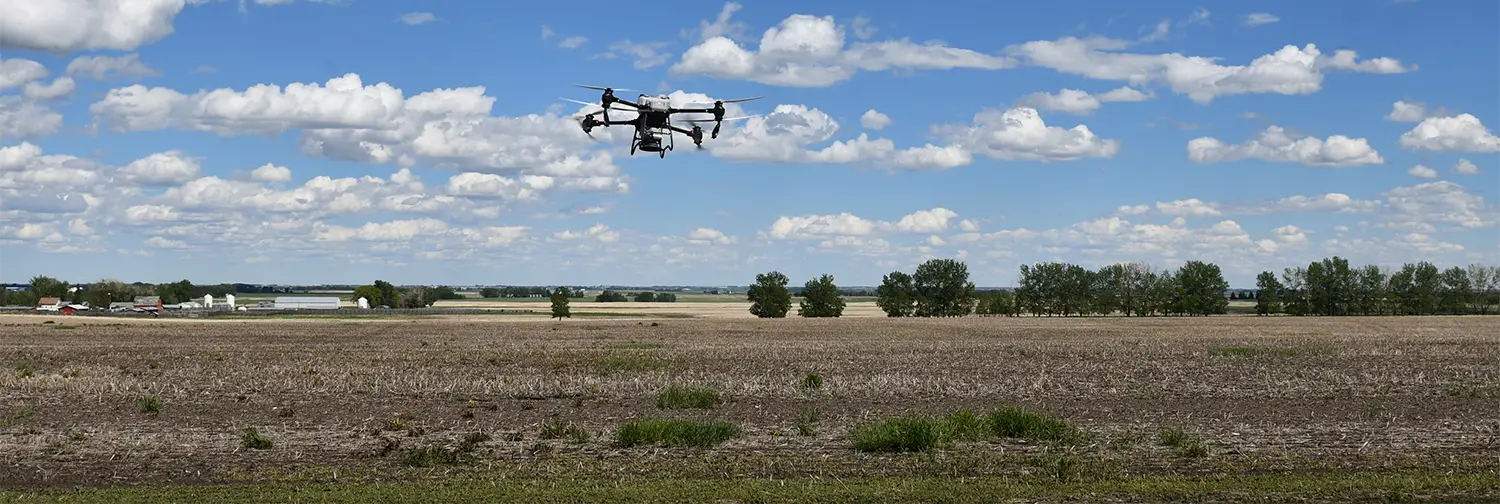
One practical application was identified on Field 13-14, located just southeast of the main College campus, which is currently being transitioned out of cultivated crop production as part of our normal crop rotation. The original plan for the field was to seed silage barley, mixed with perennial forage seeds, to allow for some short-term crop production as well as long-term plant establishment and field restoration. However, following the significant rainfall received in early June, the field conditions were too wet to support conventional seeding equipment without waiting for the field to dry out.
To address this challenge, the sprayer drone provided an alternative method for establishing the forage stand. Using its spreading capability, seed was able to be distributed across the field without the need for heavy equipment traffic, allowing field operations to continue despite the wet, unfavourable ground conditions. This application demonstrated how drone technology can offer flexibility in field management and provide practical solutions when traditional equipment is limited by factors outside of a producer’s control, such as weather and soil conditions.
This is the first time that Olds College has used a drone for seeding, marking another novel technology application and experiment for the Smart Farm!
Advancing Canada’s Agriculture Industry
The Olds College Smart Farm creates a place for producers, industry partners, students and faculty to look at the opportunities and challenges facing the agriculture industry and investigate solutions to evolve agriculture practices.
The Smart Farm is working towards providing producers with real-life applied research to help them make informed decisions about implementing technology in their own operations.