
Rainfall, snowmelt, and unplanned discharges can carry sediments, nutrients, salts, organic matter, and other contaminants through the High Plains Industrial Park (HPIP) stormwater drainage system. These short-term events can increase pollutant loading to downstream wetlands at Shuttleworth Conservation Park (SCP).
Olds College Centre for Innovation (OCCI) is leading this one-year NSERC Applied Research and Development (ARD)-funded project in collaboration with Highfield Investment Group (HIG), CIMA+ and Mount Royal University. The project will characterize HPIP’s stormwater drainage and management system to better understand how land use, drainage infrastructure and stormwater pathways contribute to pollutant loading at SCP.
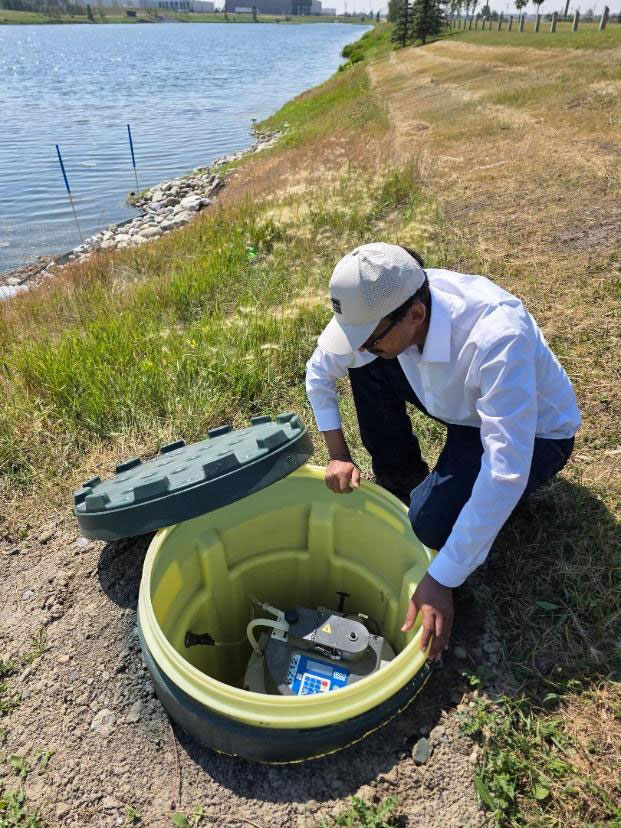
As part of the project, a telemetry-enabled, flow-triggered autosampler will collect water samples during stormwater events such as rainfall, snowmelt and unplanned discharges. This event-based approach will help capture short-duration contamination events that can be missed by conventional grab sampling.
The research will combine event-based sampling with drainage mapping and water quality data analysis to identify pollutant sources and drainage pathways and better distinguish between point and non-point source pollution.
The findings will support targeted remediation, infrastructure improvements, regulatory compliance, and cost-effective stormwater management at HPIP. The monitoring approach and lessons learned may also be applicable to other industrial developments across Canada.
Funders/Partners: NSERC Applied Research and Development (ARD) Grant; Highfield Investment Group (HIG); CIMA+; Mount Royal University