
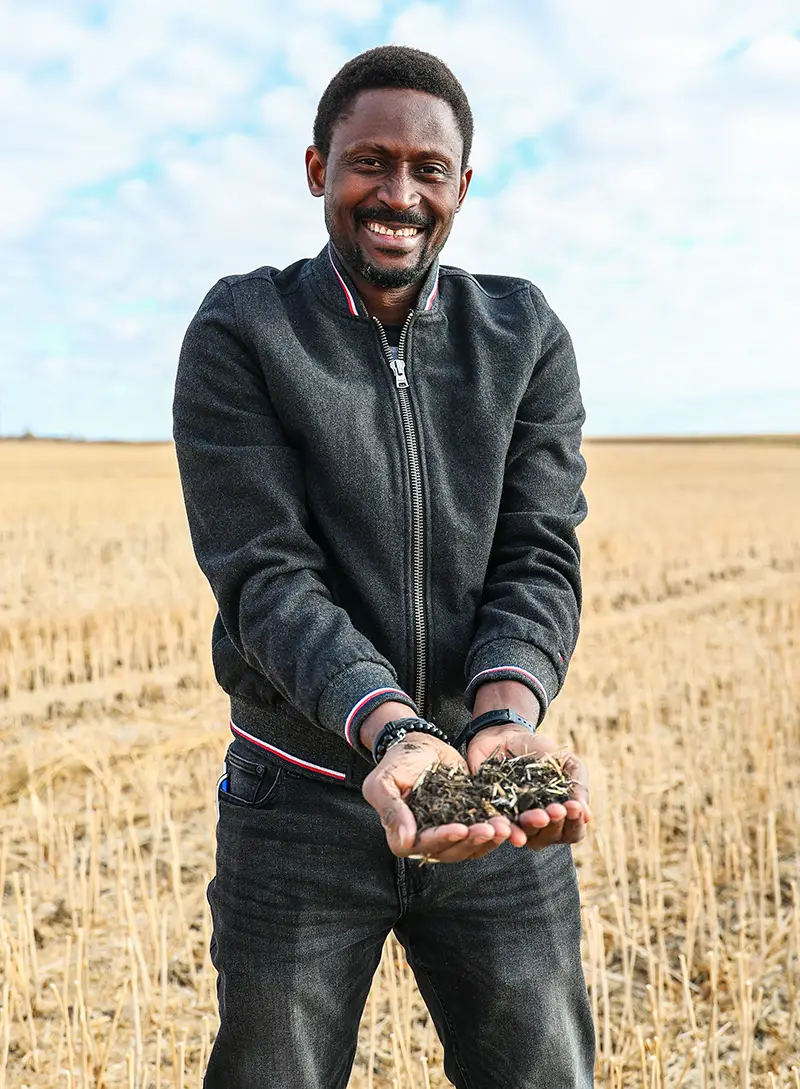
 Looking for a way to test your soil quality in the field? Dr. Semeton Amosu, Research Associate with the Environmental Stewardship team at the Olds College Centre for Innovation, has developed a prototype of a comprehensive soil health scorecard called the Olds College Assessment of Soil Health (OCASH) to support farmers and agronomists in evaluating the health and potential productivity of their soils.
With 20 soil health indicators made up of physical, chemical, biological, plant and environmental characteristics, this tool comes with an assessment guide allowing users to rate indicators and collectively provide the health status of soil. From biodiversity to pH levels to heavy metals – the scorecard relies on using human senses to rate the soil odour, texture, organic matter colour, surface and residue cover – to name a few.
The scorecard's goal is to allow producers to quantify indicators in their soil and complete a simple calculation to rate the health of their soil, allowing them to gain an initial diagnosis of the soil’s vital signs in the field before diving deeper into analysis.
“Soil quality assessment alternatives were the core part of my PhD work, and I've always wanted to develop a simple tool to evaluate soil quality and health,” says Amosu. “After using other soil quality cards, I decided to create the OCASH scorecard for a more simplified analysis.”
First developed in May 2025 as a quantifiable version of the Alberta Soil Quality Card, the OCASH combines traditional agronomic indicators with environmental metrics that are typically underrepresented in existing soil health scorecards and laboratory tests.
The commonly known Agriculture and Horticulture Development Board's soil health scorecard emphasizes similar core indicators such as pH, soil structure, organic matter and biological activity through earthworm counts; however, it relies heavily on laboratory-based assessments of soil fertility and microbial activity. Whereas the OCASH scorecard is an in-field diagnostic tool that will measure soil health both for agricultural productivity and broader environmental sustainability.
During the 2026 growing season, Amosu will be validating the correlation of the OCASH scorecard with other established quantitative methods such as visual assessment tools, soil test kits and laboratory soil test results on the Olds College Smart Farm in both Alberta and Saskatchewan. This will test if the OCASH tool is a field-deployable and scalable solution for soil health across diverse agroecological systems. Amosu’s goal is to have a very useful tool to help farmers and agronomists by the spring of 2027, and hopes to one day have it available on the App Store.
Stay tuned for updates on this research project in the upcoming study Evaluating Soil Health Assessment Tools.
The Smart Farm is working towards providing producers with real-life applied research to help them make informed decisions about implementing technology in their own operations.