
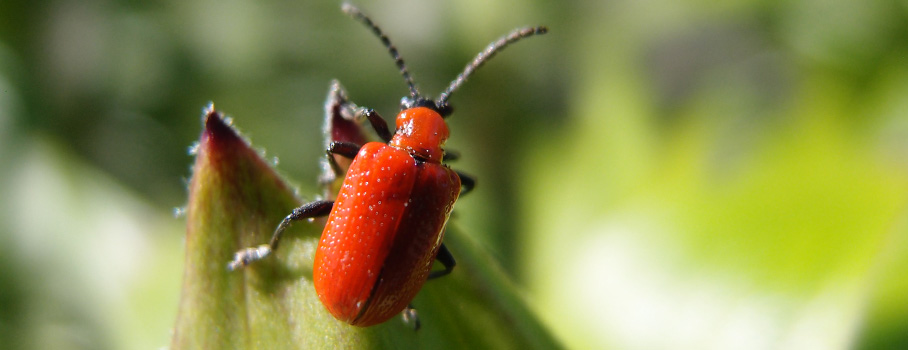
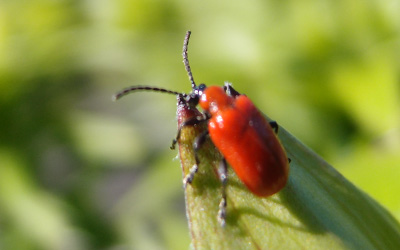
The Lily Beetle (Lilioceris lilii), is a bright red-scarlet beetle which feeds primarily on lilies (Lilium spp.), and fritillaria (Fritillaria spp.). They cause extensive damage to all parts of the lily plant above ground. This beetle, an introduced pest from Asia, was first discovered in Montreal, Canada in the early 1940s. The beetle’s first arrival to Canada is believed to be through the lily trade, getting a free ride on lilies or bulbs in the adult or egg state. The Red Lily Beetle is now a resident of every province in Canada except British Columbia.

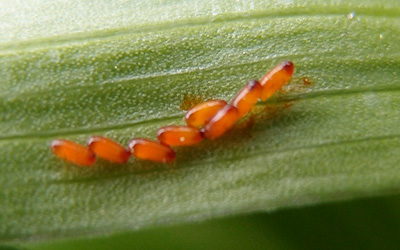
Adults overwinter in the soil or under leaf litter. They may overwinter near the plants they red on during the past summer but are not restricted to theses sites. They emerge in the spring in late April to early May, disperse or 1-2 weeks, then settle down to feed and find a mate. The female then lays eggs on the underside of the leaf in an irregular line. The eggs are reddish-orange in color and only 1-2mm in length. A single female beetle can lay between 200-300 eggs. The average hatching period is 8-10 days.
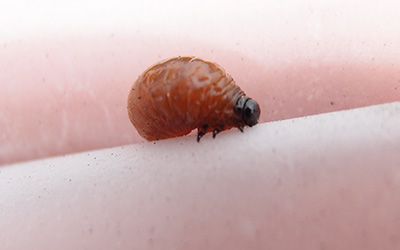
The eggs hatch into a yellowish-white larva with a black head. The lily beetle larvae deposits its faeces on its back as a protective shield against the hot sun and predators. They feed for 20-25 days, and will devastate the lily plant if not detected. It has a habit of feeding on the underside of the leaf at first, making them more difficult to be detected. Early feeding is limited to skeletonizing the under side of the leaf surface. Once they are more mature, they will move about freely and devour the above ground plant including leaves, flower buds and open flowers.
When the larvae are mature and ready to pupate, they begin the transformation into adult beetles. The larvae will borrow into the soil and change color to orange. It creates a waterproof cocoon around its body in preparation for the transformation period which takes, on average, 21 days. The adult beetle will then emerge to the surface and continue to feed on lily plants until early fall. The colder weather triggers the adults to return to the soil where they overwinter, emerging to the following spring to repeat their life cycle again. In Alberta, our growing season is short, we only have to endure one cycle per year.
For small infestations, control methods should be non-chemical if at all possible. As soon as the lilies emerge in spring, keep your eyes out for signs of this pest. Picking the adult beetles and larvae and checking the underside of lilies for eggs in spring or summer is the first step. Removal of breeding-age adults before they have the opportunity to reproduce will help in the control or elimination of this pest. Larvae are easily scraped off leaves or squished wearing gardening gloves. Lily beetle larvae are more vulnerable to chemical applications than adult beetles, and they also do the most damage.
If picking the beetles and/or larvae by hand is impossible, you may need to consider a visit to a local greenhouse or nursery for chemical pest control products. The parasitic wasp Tetrastichus setifer, native to Asia, has been released in New England, Ottawa and recently in southern Alberta. This wasp is able to withstand Canadian winters and is quickly establishing in beetle infested areas. Please do not use chemical controls if the wasp is released in your area.
This project began in 2014 with a two-year research grant from the Alberta Association of Colleges and Technical Institutes, followed by annual funding for a student technician from the Alberta Regional Lily Society from 2016-2021. In 2014, Dr. Fry released the parasitoid Tetrastichus setifer to establish a local population for biological management of the lily beetle. With subsequent releases on campus, in Airdrie and in Calgary occurring in 2015 and 2016, they monitored parasitism rates and spread occurred from 2017-2021 (see the 2021 report).
All lilies on the campus were surveyed for larvae beginning in June and ending in September 2021. A total of 172 lily beetle larvae, substantially up from five in 2020 and comparable to 128 in 2019, were collected from the lily plots in 2021. The larvae were fed on excised lily leaves and allowed to pupate in plastic containers filled with vermiculite wetted with tap water. Nineteen adult lily beetles emerged from the pupae, an emergence rate of 11 per cent.
By tracking the lily infestation on Olds College grounds, we established life cycle stages, timing of life cycle stages, conducted a comprehensive literature review in support of the research efforts, quantified lily infestations province-wide, and began outreach efforts to educate the public and industry.
If you have found this invasive pest on your lilies, please provide a picture and report your findings to confirm the identity and map out the spreading range of this pest. Please Contact:
Alberta Regional Lily Society
lilybeetle@arls-lilies.org
Olds College Ken Fry Ph.D
KFry@oldscollege.ca
Carlton University
lilybeetletracker.weebly.com